Sheldon Japanese beetle control program
Silent SpringThe Sheldon Japanese beetle control program was an effort to eradicate an invading insect through repeated, large-scale chemical treatments; it instead became a case of extensive wildlife and domestic-animal losses for only temporary suppression of the beetle. Beginning in 1954 in eastern Illinois, the campaign spread across Sheldon and neighboring Iroquois County, its acreage rising from 1,400 to 131,000 by the end of 1961. The contrast between the promise of eradication and the observed damage makes the program a central example of how a narrowly defined pest-control objective could reorder an entire local ecology.
Launch and escalation
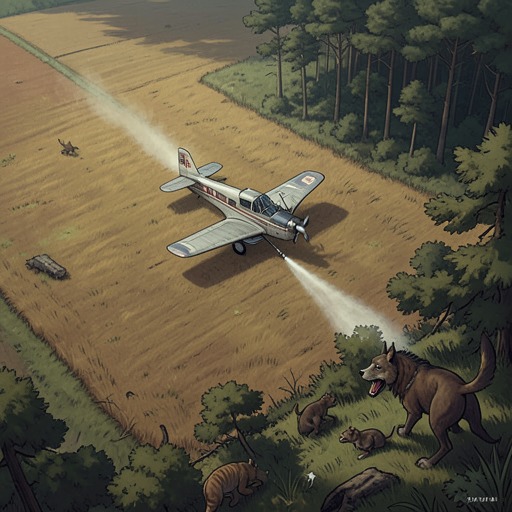
In 1954, the United States Department of Agriculture and the Illinois Department of Agriculture began treating areas along the Japanese beetle’s advance into Illinois. The agencies presented intensive spraying as a way to destroy the invading populations. That year, dieldrin was applied by air to 1,400 acres; a further 2,600 acres received treatment in 1955, after which the initial task was apparently regarded as complete.
The campaign did not end with those first applications. More chemical treatments were called for, and by the end of 1961 the treated area had reached about 131,000 acres. In the early Sheldon treatments, dieldrin was applied at three pounds per acre. Later, researchers resumed studies that had been interrupted in 1955 and found the chemical had been changed to aldrin, described as 100 to 300 times as toxic as DDT in tests on quail. Thus the program expanded not only in geographic reach but also through the use of a more toxic insecticide.
Exposure and losses
The danger to wildlife arose from the chemicals themselves and from the conditions their application created. Dead and dying insects of several species remained conspicuous for about two weeks after treatment, providing food for insect-eating birds. Dead earthworms were also seen after gentle rain, and robins may have eaten the poisoned worms. Rain left puddles in the treated area; birds seen drinking or bathing in them were exposed as well. These pathways carried the effects beyond the beetle targeted by the spraying.
The losses among birds were severe. Brown thrashers, starlings, meadowlarks, grackles, and pheasants were virtually wiped out in the early affected areas; biologists described robins as almost annihilated. Although some nests and eggs were found, none contained young birds, raising concern that surviving birds might have been rendered sterile. By 1960, robins, grackles, starlings, and brown thrashers had disappeared from Donovan, while populations of these and other birds were sharply reduced elsewhere.
Mammals and farm animals were also affected. Ground squirrels were virtually annihilated, and dead muskrats and rabbits were found in treated areas. The fox squirrel, previously relatively common in Sheldon, disappeared. Farm cats suffered particularly heavy losses: about 90 percent were killed during the first season of spraying. By 1960, every species of wild mammal known to inhabit the area had experienced losses.
Consequences for wildlife and community life
The damage reached beyond individual wildlife populations into local activities and livelihoods. Pheasant hunters saw the number of broods on treated land fall by roughly half, and the number of young in each brood also declined. Hunting that had previously been good in those areas was virtually abandoned because it no longer yielded worthwhile results. The reduction in birds and mammals was therefore registered not only in biological surveys but in the diminished use of the surrounding countryside.
The consequences were not captured fully by the available research. Biological field studies received only about $6,000 during the program’s eight years, even as the federal government spent about $375,000 on control work, with additional sums spent elsewhere. The biologists’ measured destruction was therefore a minimum estimate: their limited funding prevented comprehensive coverage, and fuller investigation might have revealed still greater losses. The imbalance between extensive chemical operations and scant ecological study shaped what could be known about the campaign’s effects.
Results and historical significance
Despite the extensive damage caused in the name of eradication, treatment of more than 100,000 acres in Iroquois County over eight years appears to have produced only temporary suppression. The Japanese beetle continued its advance. The campaign’s scale and its biological costs therefore did not deliver the lasting outcome promised by the eradication rationale.
The longer history of the beetle further complicates the case for the program. During its first dozen years in the United States, the insect increased rapidly without the restraints that kept it in check in its native land. By 1945, however, it had become a pest of only minor importance across much of the territory it had reached. That decline was attributed largely to the introduction of parasitic insects from the Far East and the establishment of disease organisms fatal to the beetle. Set against this history, the Sheldon campaign illustrates the contrast between chemical eradication and ecological restraints: the former brought widespread collateral damage, while the latter had already contributed to the beetle’s decline elsewhere.